

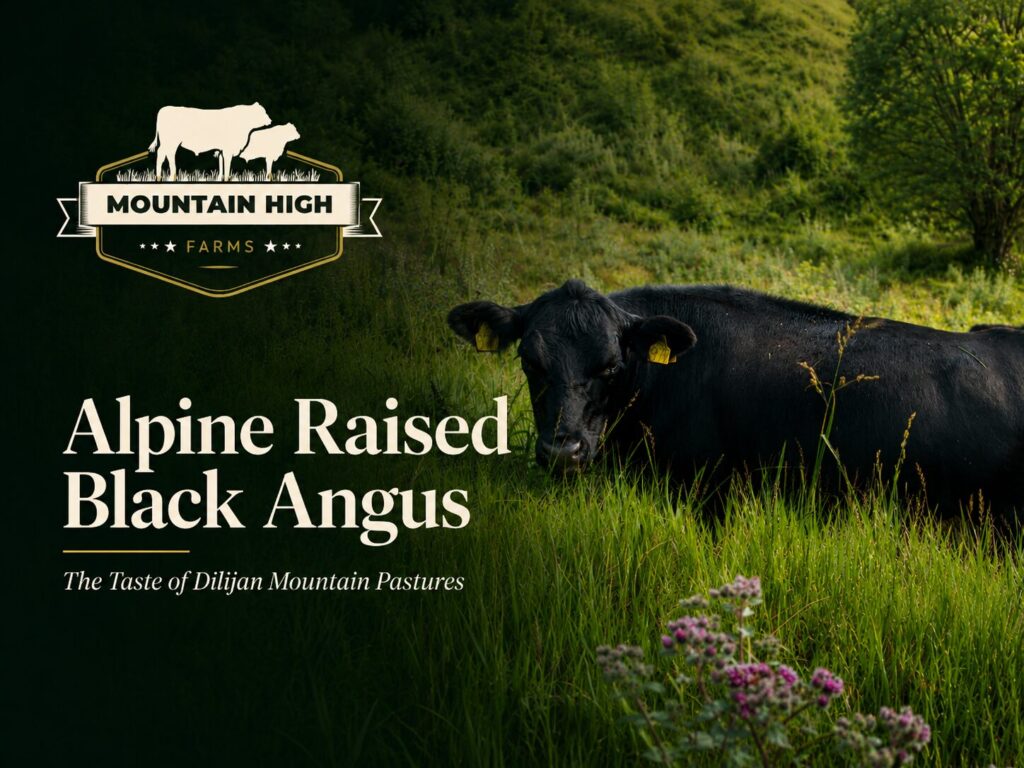
Alpine Raised Black Angus: The Taste of Dilijan Mountain Pastures
Black Angus beef is known for tenderness, marbling potential, and rich eating quality. But breed alone does not create exceptional beef. The final character of Black Angus beef is shaped by the animal’s full environment: where it grazed, what plants it ate, how it moved, how the land was managed, and whether the consumer can trust the origin of the product.
At Mountain High Farms, this is the logic behind Alpine Raised Black Angus: Black Angus genetics raised in the Dilijan highlands, shaped by alpine meadows, wild herbs, forest-edge grazing, seasonal acorn finishing, highland sunlight, animal movement, regenerative management, and full traceability.
This is not anonymous Black Angus beef. It is Black Angus beef with origin, identity, and a visible connection to place.
Black Angus Genetics, Powered by Dilijan Mountain Management
At Mountain High Farms, Black Angus cattle provide the genetic foundation. The breed is valued for tenderness, marbling potential, and rich beef flavor. But genetics only create potential. The final product depends on the full raising system.
A Black Angus animal raised mainly on concentrates or grain feed, under stress, or in confined conditions will not produce the same result as an animal raised on diverse pasture with good welfare, proper finishing condition, low-stress handling, and careful processing.
This is why Mountain High Farms does not rely only on the term “Angus.” Our advantage is the combination: Black Angus genetics, Dilijan alpine meadows, regenerative management, seasonal acorn finishing, and traceability.
Why Dilijan Mountain Pastures Matter
The Dilijan region gives Mountain High Farms a specific natural identity. Dilijan National Park is one of Armenia’s important protected landscapes, known for forested mountains, biodiversity, natural monuments, and mountain ecosystems. Its flora includes hundreds of vascular plant species, including rare and Red Book-listed plants.
This landscape matters because alpine meadows are not uniform grass fields. They are living botanical systems shaped by altitude, rainfall, soil, sunlight, forest edges, and seasonal plant growth. The broader Dilijan ecosystem is known for rich flora, medicinal plants, wild herbs, wild fruits, forest species, oak areas, and rare plants.
For Black Angus cattle, this means a more complex grazing environment. The animal is not consuming a single industrial ration. It is selecting from grasses, legumes, meadow plants, wild herbs, forest-edge vegetation, and seasonal forage. That botanical diversity is one of the core advantages of Alpine Raised Black Angus.
Wild Herbs, Meadow Plants, and the Taste of Place
The flavor of Black Angus begins before the kitchen. It begins on the pasture.
Mountain pasture research supports the link between botanical diversity and animal-product character. Secondary metabolites from mountain pasture plants, including terpenoids and phenolic compounds, can transfer into animal products or influence digestion and fatty acid composition, contributing to sensory qualities and terroir in meat and dairy products.
The principle is clear: pasture affects diet, diet affects the animal, and the animal’s life affects the beef.
Recent grass-fed beef research also supports the broader forage-to-meat connection. A 2025 study found that grass-fed beef contained 3.1 times higher phytochemical antioxidants than grain-fed beef, linked to much higher phytochemical content in forage. The same research reported higher vitamin A and vitamin E levels in grass-fed beef compared with grain-fed beef in the systems studied.
For Mountain High Farms, the message is direct: Alpine Raised Black Angus gains character from real pasture diversity, not from artificial flavor or anonymous feeding.
Forest-Edge Grazing and Seasonal Acorn Finishing
The Dilijan highlands are not only open pasture. They are a mountain mosaic of meadows, clear spring water, forest edges, oak areas, shade, airflow, wild plants, and seasonal mast.
During mast periods, oak acorns become part of the natural forest-edge landscape. At Mountain High Farms, seasonal acorn finishing is not an industrial feed formula. It is a forest-mast layer within the broader pasture-based system.
The foundation remains mountain pasture: grasses, legumes, wild herbs, clean water, animal movement, and regenerative grazing. Acorns add a seasonal forest signature that connects the beef even more clearly to the Dilijan landscape.
This is a strong distinction. Alpine Raised Black Angus is shaped not only by pasture, but also by forest-edge grazing and seasonal oak mast.
Highland Sunlight and Black Angus Adaptation
Alpine environments expose cattle to stronger sunlight and higher ultraviolet radiation than lowland areas. The World Health Organization states that UV levels increase by approximately 10% with every 1,000 meters of altitude because thinner air absorbs less UV radiation.
This is especially relevant for Black Angus cattle. Their dark coat absorbs more solar radiation than lighter coats, and research on cattle coat color and thermoregulation shows that black or dark-coated cattle absorb more short-wave solar radiation.
In the Dilijan highlands, this makes animal management part of the product story. Sunlight, shade, airflow, clean water, cooler nights, movement, and low-stress grazing all shape the animal’s daily rhythm. These conditions work together. They influence welfare, grazing behavior, adaptation, and the way Black Angus cattle live within the mountain landscape.
For Mountain High Farms, highland sunlight is part of the alpine environment that defines how Black Angus cattle are raised. It strengthens the need for disciplined pasture management and reinforces the character of a beef system shaped by altitude, climate, movement, and care.
Regenerative Grazing Protects the Product
Alpine Raised Black Angus depends on healthy pasture. Without pasture recovery, the system loses its foundation.
Regenerative grazing is based on timing and recovery. Animals graze, then the pasture rests. Plants need leaf area to restart photosynthesis. Roots need time to rebuild strength. Soil needs cover. Pasture needs recovery before the next grazing event.
For Mountain High Farms, regenerative grazing is the land-management discipline behind the product. The goal is not only to produce Black Angus beef today. The goal is to keep the pasture productive, biologically active, and resilient for future seasons.
Healthy pasture is not separate from premium beef. It is part of premium beef.
Traceability: From Dilijan Pasture to Plate
Premium beef must be traceable. Without traceability, even strong words become weak.
“Black Angus,” “mountain-raised,” “pasture-raised,” “acorn-finished,” and “regenerative” have value only when the producer can explain what they mean in practice. Consumers need to know where the animal was raised, what it ate, how it was managed, and whether the farm stands behind the product.
Mountain High Farms’ advantage is that Alpine Raised Black Angus is connected to a real place, a real herd, and a real farming system. It is not anonymous meat. It is traceable beef from pasture to plate.
The Mountain High Farms Advantage
Alpine Raised Black Angus by Mountain High Farms is built on five advantages.
First, Black Angus genetics provide the foundation for premium beef quality.
Second, Dilijan alpine meadows provide botanical diversity, clean air, altitude, wild herbs, medicinal plants, and seasonal forage.
Third, forest-edge grazing and seasonal acorn finishing add a distinctive forest-mast signature.
Fourth, highland sunlight, cooler nights, animal movement, and welfare management shape the animal’s daily life in an alpine environment.
Fifth, traceability and regenerative grazing connect the final product to land, origin, and trust.
This combination cannot be copied by anonymous imported beef, feedlot beef, or generic pasture claims. It is a place-based product with a clear commercial identity.
The Taste of Dilijan Alpine Meadows
Alpine Raised Black Angus is the result of a complete system.
It begins with Black Angus genetics. It develops on Dilijan alpine meadows. It gains character from wild herbs, meadow plants, forest-edge grazing, seasonal acorn finishing, highland sunlight, cooler nights, animal movement, and regenerative management. It reaches the consumer through traceability.
At Mountain High Farms, Alpine Raised Black Angus is not just beef raised in the mountains. It is beef shaped by the mountain itself.
Written by Ashot Boghossian, for Mountain High Farms
Leave a reply
Leave a reply