

Born on Alpine Pasture: How Mountain High Farms Raises Strong Black Angus Calves
Black Angus cattle are known for maternal ability, adaptability, fertility, and strong calf performance. But even with good genetics, a successful calf is never guaranteed by breed alone. Calf survival depends on how the cow is managed before birth, how the calving environment is selected, how quickly the newborn receives colostrum, and how well the producer reads the first signs of weakness, cold stress, difficult birth, or poor cow-calf bonding.
In a mountain pasture system, calving is both natural and demanding. The open pasture gives the cow space, clean ground, fresh air, and the ability to express her maternal instincts. At the same time, alpine conditions require serious management. Spring weather can shift quickly. Wind, rain, wet grass, mud, cold nights, and delayed pasture growth can all affect the newborn calf during its most vulnerable hours.
This is why successful pasture calving is not a “leave the cows alone” system. It is a biological production system based on observation, timing, animal condition, pasture selection, and timely intervention when needed.
At Mountain High Farms, this system is central to how we raise Black Angus cattle.
What Mountain Pasture Calving Means
Mountain pasture calving is the practice of allowing cows to give birth in open pasture conditions, in a natural grazing environment, while applying professional herd monitoring and health management.
The purpose is not to remove management from the process. The purpose is to create the right natural conditions for the cow and calf to perform well.
A well-managed calving pasture should provide clean ground, dry lying areas, natural wind protection, safe access to water, enough space for cows to separate before birth, and good visibility for the farm team. The location must also allow access for intervention if a cow or calf needs help.
This is especially important in alpine systems. A pasture may look green, but that does not automatically make it a safe calving site. The best calving pasture is not simply the pasture with grass. It is the pasture with the right combination of forage, drainage, shelter, visibility, and animal comfort.
For Black Angus cattle, this matters because the breed’s maternal strength expresses best when the environment supports natural behavior. A cow needs space to isolate before calving, clean the calf, bond with it, and let it nurse without excessive herd pressure.
What Must Be Observed During Calving
The most important management tool during calving is careful observation.
Before calving, cows may show udder development, swelling around the vulva, relaxation near the tail head, restlessness, separation from the herd, reduced grazing, tail lifting, or repeated lying down and standing up. These signs help identify which cow is close to birth.
During active labor, progress matters. A cow should show steady advancement once the calf begins entering the birth canal. If labor is prolonged, if there is no visible progress, if only one leg appears, if the head appears without both front legs, if the calf is backward and not advancing, or if the cow becomes exhausted, the situation requires assessment.
After birth, the calf becomes the priority. A strong calf should breathe normally, sit upright on its chest, lift its head, attempt to stand, search for the udder, nurse, and remain close to the cow. These behaviors are not just “good signs”; they are biological indicators of energy, oxygen status, neurological function, and early immune survival.
The cow must also be observed. She should clean the calf, allow nursing, remain attentive, and show protective but manageable maternal behavior. A cow that walks away, refuses the calf, fails to let it nurse, or repeatedly moves before the calf can stand creates risk.
At Mountain High Farms, the real standard is not simply that a calf is born alive. The standard is that the calf is breathing, upright, warm, nursing, and bonded with the cow.
Calving Directly on Pasture at Mountain High Farms
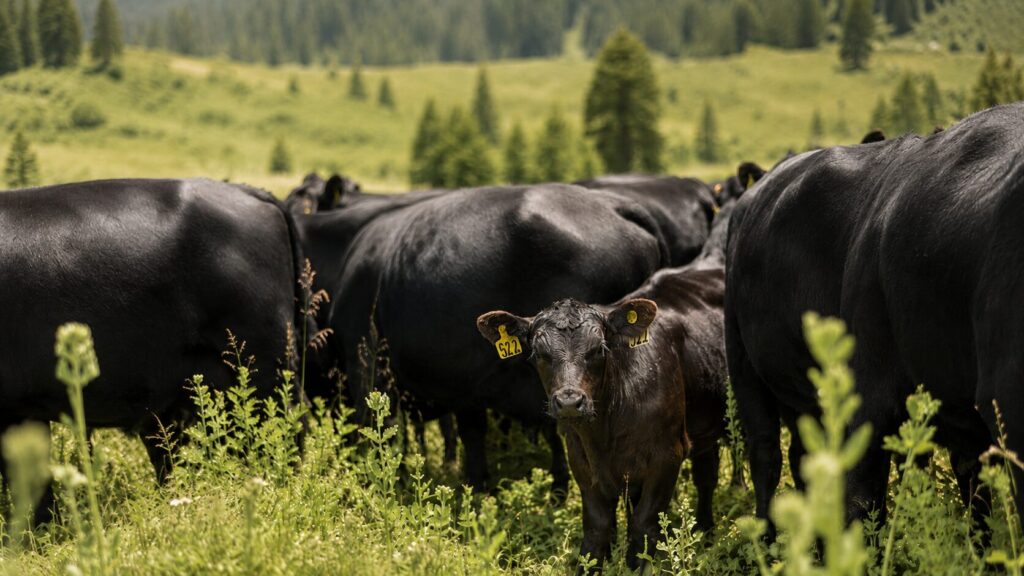
At Mountain High Farms, our Black Angus cows calve directly on alpine pasture.
We do not use barns, calving sheds, confined calving pens, or artificial maternity facilities. The calves are born in the same pasture-based environment where the cows graze, raise their calves, and form the foundation of our beef system.
This is a deliberate management decision. Our cattle are not raised in an industrial or confinement-based model. They live on pasture, perform on pasture, and begin the next generation on pasture.
That choice carries responsibility. Pasture calving must be planned and monitored with precision. The cow must be in proper body condition. The pasture must be selected for safety, not only forage. The team must observe without disturbing. The equipment must be ready. Intervention must be available, but not excessive.
The result is a calving system that supports natural maternal behavior while maintaining professional herd management.
Why Calving Season Is Timed With the Land
Calving season must match the biology of the cow and the productivity of the pasture.
After calving, the cow enters peak lactation. This is one of the most nutritionally demanding periods of the production cycle. She must produce milk, recover from birth, maintain body condition, and prepare for the next breeding season.
At Mountain High Farms, calving is aligned with spring pasture growth. This allows the cow’s increasing nutritional demand to meet the return of fresh forage. When the timing is right, pasture growth supports milk production, calf development, cow recovery, and reproductive performance.
This is one of the main advantages of a pasture-based system. Instead of forcing the cow’s biology into a barn-feeding model, the system works with the seasonal productivity of the land.
But timing requires discipline. If calving begins before the pasture is ready, cows may depend too heavily on winter reserves and strategic hay. If calves are born during cold, wet, windy periods, they face higher stress. If pasture recovery is poor, lactating cows may lose condition.
This is why calving cannot be separated from grazing management. Winter stockpiling, strategic hay, mineral balance, pasture rest, spring turnout, and cow body condition all affect calf survival.
Cow Condition Before Birth
A strong calf usually begins with a properly prepared cow.
The cow should enter calving in functional body condition: not thin, not over-conditioned. A thin cow may produce weaker calves, lower-quality colostrum, less milk, and slower reproductive recovery. An over-conditioned cow may face higher risk of calving difficulty.
Body condition affects more than appearance. It influences calf vigor, colostrum production, maternal behavior, lactation, and the ability of the cow to return to breeding condition.
In a regenerative pasture system, this means that nutrition must be managed months before calving. Pasture reserves, hay quality, mineral access, winter energy balance, and herd grouping all influence the outcome.
A calving problem in April may have started as a nutrition problem in February.
Colostrum: The First Biological Protection
Colostrum is the calf’s first immune protection and first major energy source.
Newborn calves do not receive full immune protection before birth. They depend on colostrum to absorb antibodies during the first hours of life. Colostrum also supplies energy, fat, vitamins, and biological signals that help the calf transition from the womb to the outside environment.
The practical rule is strict: the earlier the calf nurses, the better. A calf that delays nursing becomes weaker, colder, and more vulnerable. Even if it appears normal at first, failure to receive colostrum early can create serious health risk later.
This is why a newborn calf must be observed for actual nursing, not only standing. A calf may stand and still fail to nurse. A cow may have milk and still not allow nursing. A calf may appear active but receive too little colostrum.
For pasture calving, this is one of the most important checks. The farm team must confirm that the calf has found the udder and received colostrum.
Cold Stress in Alpine Conditions
In mountain calving systems, cold stress is one of the main threats to newborn calves.
Cold stress is not caused only by low air temperature. Wind, rain, wet hair coat, muddy ground, and lack of shelter can remove body heat rapidly. A wet calf lying in wind can lose energy quickly, even when the temperature is not extremely low.
A calf that becomes cold has less strength to stand and nurse. If it does not nurse, it loses both immune protection and energy. This creates a dangerous cycle: cold calf, weak calf, no colostrum, lower survival.
Good pasture selection reduces this risk. Calving areas should have natural wind protection, dry ground, drainage, and safe observation access. South-facing slopes, sheltered sections, forest edges, and well-drained zones may be more suitable than exposed wet areas.
In our alpine environment, microclimate matters. Wind direction, slope, shade, wet zones, night temperature, and access routes must all be considered.
When Intervention Is Needed
The best pasture calving system allows most cows to calve naturally. Excessive handling can disturb the cow, disrupt bonding, and create stress.
But non-intervention is not the same as good management.
Intervention may be needed when labor does not progress, when the calf is malpositioned, when the cow is exhausted, when the calf is born weak, when the calf does not breathe properly, when it cannot stand, when it does not nurse, or when the cow rejects it.
The first step is diagnosis. The position of the calf, the condition of the cow, the timing of labor, and the behavior of the newborn must be assessed before action is taken.
Assistance must be calm, clean, and technically correct. Rough pulling, unnecessary force, or delayed action can injure the cow and weaken the calf. The goal is always to protect the cow-calf pair while preserving the natural process as much as possible.
Hygiene Still Matters on Pasture
Open pasture reduces some disease pressure compared with repeated calving in confined spaces, but hygiene remains essential.
Any equipment used for calving assistance, colostrum feeding, weak-calf support, or treatment must be clean. Gloves, ropes, bottles, tubes, disinfectants, and basic tools should be prepared before the season begins.
A dirty feeding tube, contaminated bottle, or poorly cleaned tool can turn emergency help into a disease risk.
Pasture calving depends on clean land and clean decisions. The calf should be born on fresh ground, receive colostrum early, avoid unnecessary exposure to pathogens, and be handled only when handling is useful.
Why This System Matters for Beef Quality
Premium beef begins before finishing.
It begins with the cow, the pasture, the birth environment, and the early life of the calf. A calf born on pasture, raised by its mother, grown on alpine forage, and managed under a traceable production system represents a different kind of beef production.
At Mountain High Farms, Black Angus beef is not defined only by breed. It is defined by the production system behind the breed.
Our system connects genetics, pasture, maternal performance, calf development, animal welfare, and land health. Calving directly on pasture is one of the clearest expressions of that system.
The calf is not born in an artificial facility and later marketed as pasture-raised. It begins life on pasture.
That distinction matters. It reflects how the animal was raised, how the land was used, and how the final product was produced.
The Mountain High Farms Calving Standard
Our calving standard is practical and strict.
The cow must be prepared before birth. The pasture must be selected for safety and comfort. The calving process must be observed without unnecessary disturbance. The newborn must breathe, sit upright, stand, nurse, and bond with the cow. Colostrum intake must be confirmed. Weather risk must be managed. Intervention must be timely when needed, but limited when nature is working properly.
This is the balance at the center of professional pasture calving: trust the cow, but verify the outcome.
Strong Calves Begin With Land, Cow, and Management
Black Angus mountain pasture calving is a serious production system. It combines breed strength, maternal instinct, pasture ecology, animal health, and skilled observation.
At Mountain High Farms, our calves are born directly on alpine pasture, without barns, calving sheds, confined calving pens, or artificial maternity facilities. This reflects our broader approach to beef production: natural, pasture-based, traceable, and professionally managed.
We do not use facilities to replace nature. We use management to support nature.
That is where our Black Angus beef begins: with healthy land, strong cows, vigorous calves, and a production system rooted in the alpine pastures of Mountain High Farms.
Written by Ashot Boghossian, for Mountain High Farms
Leave a reply
Leave a reply